
Red Sage vs Common Sage: Medicinal Root or Culinary Leaf?

The red sage vs common sage comparison involves two different species and two different plant parts. Red sage supplements often contain root material from Salvia miltiorrhiza. Common sage usually means the aromatic leaves of Salvia officinalis, the familiar culinary spice.
Garden Organics uses a species-and-part editorial rule for comparisons within the large Salvia genus. Sharing the word sage does not make two products botanically or chemically interchangeable.
Are red sage and common sage the same plant?
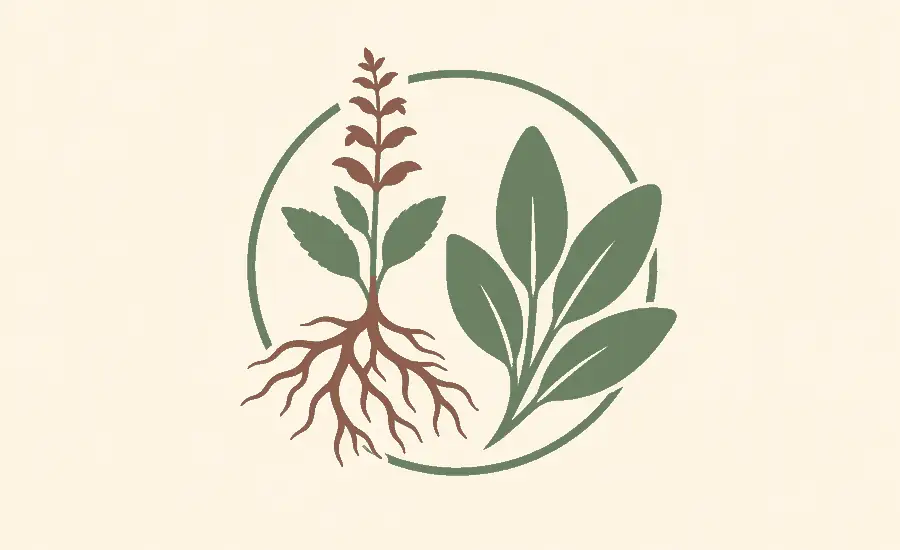
No. Red sage and common sage belong to the same genus and family, but they are separate species.
Red sage in supplement and Chinese herbal contexts usually refers to Salvia miltiorrhiza Bunge. It is also known as Dan Shen or Chinese red sage. Formal herbal references focus on the dried root and rhizome.
Common sage is Salvia officinalis L. It is also called culinary sage, garden sage, or simply sage. Food products usually use its fresh or dried leaves.
| Comparison point | Red sage | Common sage |
|---|---|---|
| Typical scientific name | Salvia miltiorrhiza | Salvia officinalis |
| Botanical family | Lamiaceae | Lamiaceae |
| Common alternative name | Dan Shen or Chinese red sage | Culinary sage or garden sage |
| Typical plant part | Root and rhizome | Leaf |
| Typical retail category | Botanical supplement | Fresh herb, dried spice, tea, or supplement |
| Common preparation | Root powder or root extract | Fresh, dried, rubbed, or ground leaf |
| Interchangeable? | No. Species, plant part, and preparation differ. | |
Why does the shared word sage cause confusion?
Salvia is a large genus containing culinary, ornamental, aromatic, and traditionally used plants. Common names often shorten these distinct species to sage.
The name red sage is particularly ambiguous. Supplement sellers may use it for Salvia miltiorrhiza, while gardening sources may apply it to red-flowering ornamental plants such as Salvia coccinea. Flower color does not establish the identity of a root-based supplement.
The name common sage is more consistent, but retail products can still create uncertainty. It usually refers to Salvia officinalis. Some grocery or regional products may use another culinary Salvia species.
The Latin name resolves most naming ambiguity. A label should identify the species before the product is classified as red sage, common sage, or another type of sage.
What defines red sage as a botanical ingredient?
Red sage in the Dan Shen category is Salvia miltiorrhiza. It is a perennial plant native to parts of China and Vietnam. The reddish root gives rise to the English name used in many supplement listings.
Root and rhizome
Pharmacopoeial references identify Dan Shen as the dried root and rhizome of Salvia miltiorrhiza. Root powder, sliced root, water extract, alcohol extract, and dry extract are separate preparations of that material.
Constituent profile
The root contains several constituent groups. Frequently discussed examples include water-soluble salvianolic acids and less water-soluble tanshinones. Their proportions can vary with source material and extraction method.
Retail identity
A red sage capsule should state the Latin name and plant part. The capsule shell alone does not reveal whether it contains raw root powder, a dry extract, or a blend.
What defines common sage as a culinary ingredient?
Common sage is Salvia officinalis, an aromatic subshrub native to parts of southern Europe. Its gray-green leaves have a textured surface and a strong aroma.
Fresh leaves
Fresh culinary sage is sold as intact leafy sprigs. The ingredient remains recognizable, and its intended role is usually clear from the food label or produce category.
Dried leaves
Dried sage may appear as whole leaves, crushed leaves, rubbed sage, or ground powder. Rubbed sage has a lighter, fluffier texture than finely ground sage, so equal spoon volumes do not necessarily have equal weight.
Nonculinary formats
Common sage can also appear in teas, capsules, liquid extracts, and essential oils. These concentrated formats should not be evaluated as ordinary culinary servings.
How does root material differ from leaf material?
Roots and leaves perform different functions in a plant. Their structures and constituent profiles are not interchangeable, even when the plants belong to the same genus.
Red sage root is an underground storage and transport structure. Common sage leaf is an aromatic above-ground tissue containing volatile compounds that contribute to its flavor and scent.
Drying both materials does not remove this distinction. Dried red sage root remains root material from Salvia miltiorrhiza. Dried common sage remains leaf material from Salvia officinalis.
Research on common sage leaf should not be assigned to red sage root. Dan Shen studies should not be used to describe culinary sage.
How do their product formats compare?
A product format describes how the botanical material has been processed and delivered. It does not replace the need for a species name and plant part.
A comparison with culinary sage can include a capsule-format Red Sage product, but Garden Organics would first confirm the Latin name, root identity, extract status, and serving information shown on the physical label.
| Product format | Likely material | Important label field | Suitable comparison |
|---|---|---|---|
| Fresh common sage | Fresh leaves | Species or produce identity | Other fresh culinary herbs |
| Dried common sage | Whole, rubbed, or ground leaf | Net weight and added ingredients | Comparable dried leaf products |
| Common sage capsule | Leaf powder or extract | Species, plant part, and preparation | Similar common sage supplements |
| Red sage capsule | Root powder or dry extract | Latin name, plant part, and extract details | Comparable Dan Shen products |
| Red sage liquid extract | Extracted root constituents in a carrier | Carrier, ratio, and serving volume | Similar root extracts |
| Sage essential oil | Concentrated volatile fraction | Species and intended use | Comparable essential oil products |
Can a culinary spice be compared with a capsule?
Only at the level of identity and labeling. A spice serving and a supplement serving should not be treated as equivalent quantities.
A jar of common sage normally declares net weight and an ingredient such as sage leaves. A supplement capsule should provide a serving size, botanical identity, plant part, and ingredient amount.
Capsules may contain raw botanical powder, concentrated extract, or a multi-ingredient formula. The number of capsules does not reveal the amount or type of plant material.
A teaspoon of rubbed sage cannot be converted directly into a red sage capsule amount. The products contain different species, different plant parts, and different constituent profiles.
How does extraction affect the comparison?
Extraction transfers selected constituents from plant material into a solvent. The solvent, temperature, processing time, and botanical-to-extract ratio can influence the finished composition.
Red sage research may use water extracts, alcohol-based extracts, dry extracts, isolated fractions, or multi-herb formulas. Common sage studies may use leaf powder, tea, extract, or essential oil.
A water extract of red sage root does not represent every red sage capsule. A common sage essential oil does not represent dried culinary leaves. Product format must match the tested material closely enough to support comparison.
Standardization can provide a measurable marker specification, but it does not make two species equivalent. Markers used for Salvia miltiorrhiza are not direct comparison units for Salvia officinalis.
What should you check on the label?
Start with the back panel. Front labels often shorten plant names for readability or marketing.
Species
Look for Salvia miltiorrhiza on a Dan Shen or Chinese red sage product. Look for Salvia officinalis on a common sage product.
Plant part
Red sage products commonly identify root or root and rhizome. Common sage products usually identify leaf. An unspecified plant part weakens the comparison.
Preparation type
Determine whether the ingredient is fresh, dried, powdered, extracted, distilled, or blended. These terms describe distinct materials.
Serving unit
Record grams, milligrams, capsules, teaspoons, drops, or milliliters exactly as shown. Do not compare unlike units without product-specific data.
Other ingredients
Check carriers, capsule materials, flavors, preservatives, and additional botanicals. A blend cannot be evaluated as a single-ingredient sage product.
Can research on one sage species apply to the other?
No. Research should remain attached to the species, plant part, and preparation tested.
A paper on Salvia officinalis leaf does not establish facts about Salvia miltiorrhiza root. A study of an isolated tanshinone does not describe culinary sage. A trial using a common sage essential oil does not describe whole leaves.
Before connecting research to a retail product, verify:
- Complete botanical name
- Plant part
- Raw material or extract
- Extraction method
- Marker specification
- Serving amount and unit
- Single ingredient or formula
- Study design and tested preparation
What safety distinction should readers recognize?
Food use and concentrated supplement use are different contexts. A culinary amount of common sage does not provide a safety reference for an essential oil or concentrated capsule.
Common sage contains naturally occurring volatile constituents, including thujone in variable amounts. Red sage has a separate constituent and interaction profile. Anyone using prescription products should ask a qualified clinician or pharmacist to review the exact supplement label.
This comparison does not provide dosing instructions or establish product suitability.
Root or Leaf Product Checklist
Use this checklist when comparing red sage with common sage. It separates species identity from plant part, culinary use, and supplement format.
Read the Latin name
Confirm the complete species. The word sage alone cannot identify the product accurately.
Identify the plant part
Record whether the material is root, rhizome, leaf, or another part. Do not transfer information between plant structures.
Classify the product
Separate food, spice, tea, capsule, liquid extract, dry extract, and essential oil. Each format requires different comparison data.
Check the preparation
Determine whether the product contains raw powder or an extract. Look for the solvent, carrier, and extract ratio when relevant.
Record the serving unit
Keep teaspoons, grams, milligrams, capsules, drops, and milliliters separate. Do not make unsupported conversions.
Review standardization
Identify the stated marker and its declared amount or percentage. The word standardized alone is incomplete.
Inspect additional ingredients
Check for carriers, flavorings, capsule materials, and other botanicals. Blended products need a formula-level review.
Match the evidence
Use research that identifies a comparable species, plant part, and preparation. Reject unsupported transfers between root and leaf products.
FAQ
Are red sage and common sage the same?
No. Red sage supplements often use Salvia miltiorrhiza, while common sage is usually Salvia officinalis.
Do red sage and common sage belong to the same family?
Yes. Both belong to Lamiaceae and the genus Salvia, but they are separate species.
Which part of red sage is commonly used?
Dan Shen preparations conventionally use the dried root and rhizome of Salvia miltiorrhiza.
Which part of common sage is used as a spice?
Common sage spice consists primarily of fresh or dried Salvia officinalis leaves.
Can red sage capsules replace culinary sage?
No. A root-based supplement is not a culinary substitute for aromatic sage leaves.
Is rubbed sage the same as ground sage?
Both use dried leaves, but rubbed sage is coarser and less dense than finely ground sage.
Is sage essential oil equivalent to sage leaves?
No. Essential oil is a concentrated volatile fraction and differs from whole leaf material.
Can common sage research apply to red sage?
No direct transfer should be made because the species, plant part, and constituent profile differ.
What is the most important label detail?
The Latin species name is the first check, followed by plant part and preparation type.
Glossary
Red sage
An ambiguous common name that may refer to Salvia miltiorrhiza or an ornamental sage.
Common sage
The culinary species Salvia officinalis, usually sold for its aromatic leaves.
Dan Shen
The Chinese name associated with the root and rhizome of Salvia miltiorrhiza.
Rhizome
A horizontal underground stem that may be included with root material.
Rubbed sage
Dried sage leaves processed into a light, coarse culinary texture.
Botanical extract
A preparation made by transferring selected plant constituents into a solvent.
Essential oil
A concentrated volatile fraction separated from aromatic plant material.
Botanical-to-extract ratio
The relationship between starting botanical weight and resulting extract quantity.
Marker compound
A measured constituent used to identify or monitor an extract.
Plant part
The specific botanical structure used, such as root, rhizome, or leaf.
Conclusion
The red sage vs common sage distinction is root versus leaf and Salvia miltiorrhiza versus Salvia officinalis. Match the Latin name, plant part, and preparation before comparing products or research.
Sources Used
- Accepted taxonomy and common name of Salvia officinalis, Kew Plants of the World Online - powo.science.kew.org/taxon/urn:lsid:ipni.org:names:456833-1/general-information
- Accepted taxonomy and classification of Salvia miltiorrhiza, Kew Plants of the World Online - powo.science.kew.org/taxon/urn:lsid:ipni.org:names:456707-1
- Common sage leaf identity and culinary formats, NC State Extension Gardener Plant Toolbox - plants.ces.ncsu.edu/plants/salvia-officinalis
- Common sage terminology, research limits, and concentrated-product context, NCCIH Sage Overview - nccih.nih.gov/health/sage
- Dan Shen identity as Salvia miltiorrhiza root and rhizome, European Medicines Agency Herbal Inventory - ema.europa.eu/en/medicines/herbal/salviae-miltiorrhizae-radix-et-rhizoma
- Dan Shen raw material and marker specifications, EMA Assessment Report - ema.europa.eu/en/documents/herbal-report/assessment-report-salvia-miltiorrhiza-bunge-radix-et-rhizoma_en.pdf
- Tincture, extract, ratio, and standardization definitions, NIH Botanical Dietary Supplements Background - ods.od.nih.gov/factsheets/BotanicalBackground-Consumer
- Botanical plant-part and serving-size labeling information, NIH Dietary Supplements Background - ods.od.nih.gov/factsheets/dietarysupplements-Consumer